His melancholy was legendary, but so too was his passionate commitment to fighting injustice and tyranny. Freedom, progress, and education were not mere platitudes to him, but life goals: Nikolaus Lenau, the poet of world-weariness, was a cosmopolitan and politically liberal figure.
Born in 1802 as Nikolaus Franz Niembsch, Baron of Strehlenau, in Tschadat/Csatád—a town in the Banat region, in present-day Romania, which is now called Lenauheim in honor of the poet—he was drawn out into the wider world. He never shook the feeling of being a “restless soul on earth” until his early death.
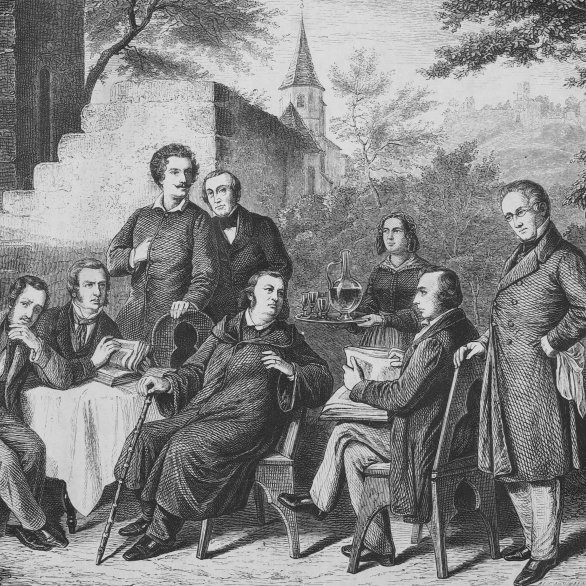
In 1831, he met Gustav Schwab in Stuttgart, which led him to become part of the Serach circle of poets centered around Justinus Kerner and Ludwig Uhland. He spent his final years in the sanatoriums at Winnenthal near Stuttgart and Oberdöbling near Vienna, where he died in 1850.
Germanists Olivia Spiridon and Georg Aescht will present the multifaceted work and legacy of this late Romantic and Vormärz poet.
The event at the Transylvanian Museum is a collaboration with the German Cultural Forum for Eastern Europe in Potsdam and the Institute for Danube Swabian History and Regional Studies at the University of Tübingen. It is sponsored by the Federal Ministry of the Interior.
Admission is free!
Born in 1802 as Nikolaus Franz Niembsch, Baron of Strehlenau, in Tschadat/Csatád—a town in the Banat region, in present-day Romania, which is now called Lenauheim in honor of the poet—he was drawn out into the wider world. He never shook the feeling of being a “restless soul on earth” until his early death.
In 1831, he met Gustav Schwab in Stuttgart, which led him to become part of the Serach circle of poets centered around Justinus Kerner and Ludwig Uhland. He spent his final years in the sanatoriums at Winnenthal near Stuttgart and Oberdöbling near Vienna, where he died in 1850.
Germanists Olivia Spiridon and Georg Aescht will present the multifaceted work and legacy of this late Romantic and Vormärz poet.
The event at the Transylvanian Museum is a collaboration with the German Cultural Forum for Eastern Europe in Potsdam and the Institute for Danube Swabian History and Regional Studies at the University of Tübingen. It is sponsored by the Federal Ministry of the Interior.
Admission is free!
This text was translated by an AI.