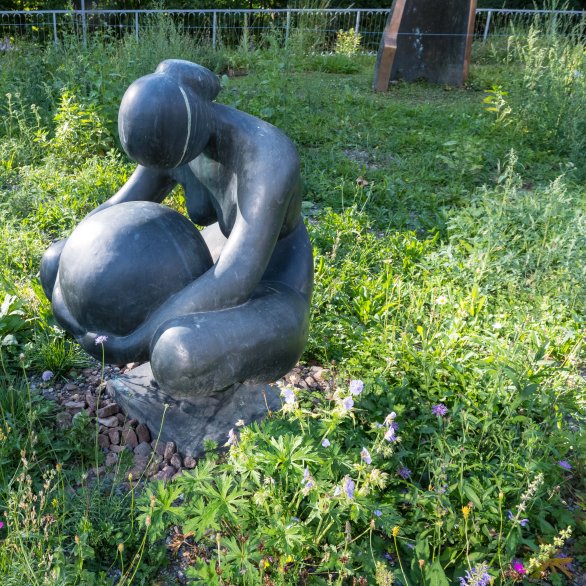
The Rehmann Museum is celebrating its 25th anniversary with an ecological vision. To mark the occasion, the 1,300 m² outdoor area is being transformed into the “Sculpture Garden Habitat.” The highlight of the festivities will be the planting of an anniversary tree—a symbol of the museum’s deep roots in the region and its simultaneous growth into the future.
For a quarter of a century, the Rehmann Museum has been an anchor for three-dimensional art in Aargau. To mark the anniversary, the museum is opening its gates: the garden is becoming a showcase for biodiversity and climate adaptation in an urban setting. Here, Erwin Rehmann’s monumental sculptures meet a dynamic ecosystem that appeals to nature and art enthusiasts alike.
Where Black Forest gneiss meets rare flora
In close collaboration with Jurapark Aargau and Katja Sattler (setzholz.ch), an expert in naturalistic gardening, new habitats have been created on the distinctive Black Forest gneiss. Special attention is given to the gray cinquefoil (Potentilla inclinata)—a botanical rarity with historical ties to Laufenburg—which finds a new refuge amidst the artworks. Climate-resilient wild perennials and shaded areas also transform the garden into a cool oasis on hot days, while intentionally darkened zones provide habitat for fireflies.
A Feast for the Senses: Tree Planting and Sound Art
The museum is celebrating its 25th anniversary with a symbolic act: the planting of a tree marks the beginning of an era in which aesthetics and ecology are inextricably linked.
The ceremony will be accompanied musically by the duo TON SUR TON. Sylvie Klijn (vocals/keys) and Christoph Utzinger (double bass) weave a translucent tapestry of sound that brings to life the delicate structures of the garden and the significance of the moment. Just as the new tree takes root, their music connects the visible with the hidden and celebrates the museum as a living, breathing process.
The anniversary year was accompanied by a participatory program that actively involved visitors:
- Joint effort against invasive plant species led by Theo Obrist.
- Wild herb workshop with naturopath Sonja Wunderlin.
- To mark the anniversary, a new audio guide links the history of the sculptures with the garden’s ecological features for the first time.
The project is primarily supported by Swisslos Aargau, Lebensraum Aargau, and the O. Lunin, Gsell, and UmweltengAGement foundations.
Admission to the event is free.
For a quarter of a century, the Rehmann Museum has been an anchor for three-dimensional art in Aargau. To mark the anniversary, the museum is opening its gates: the garden is becoming a showcase for biodiversity and climate adaptation in an urban setting. Here, Erwin Rehmann’s monumental sculptures meet a dynamic ecosystem that appeals to nature and art enthusiasts alike.
Where Black Forest gneiss meets rare flora
In close collaboration with Jurapark Aargau and Katja Sattler (setzholz.ch), an expert in naturalistic gardening, new habitats have been created on the distinctive Black Forest gneiss. Special attention is given to the gray cinquefoil (Potentilla inclinata)—a botanical rarity with historical ties to Laufenburg—which finds a new refuge amidst the artworks. Climate-resilient wild perennials and shaded areas also transform the garden into a cool oasis on hot days, while intentionally darkened zones provide habitat for fireflies.
A Feast for the Senses: Tree Planting and Sound Art
The museum is celebrating its 25th anniversary with a symbolic act: the planting of a tree marks the beginning of an era in which aesthetics and ecology are inextricably linked.
The ceremony will be accompanied musically by the duo TON SUR TON. Sylvie Klijn (vocals/keys) and Christoph Utzinger (double bass) weave a translucent tapestry of sound that brings to life the delicate structures of the garden and the significance of the moment. Just as the new tree takes root, their music connects the visible with the hidden and celebrates the museum as a living, breathing process.
The anniversary year was accompanied by a participatory program that actively involved visitors:
- Joint effort against invasive plant species led by Theo Obrist.
- Wild herb workshop with naturopath Sonja Wunderlin.
- To mark the anniversary, a new audio guide links the history of the sculptures with the garden’s ecological features for the first time.
The project is primarily supported by Swisslos Aargau, Lebensraum Aargau, and the O. Lunin, Gsell, and UmweltengAGement foundations.
Admission to the event is free.
This text was translated by an AI.