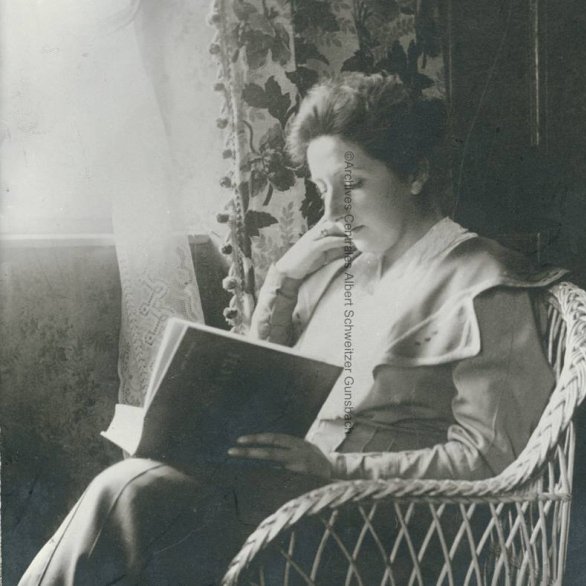
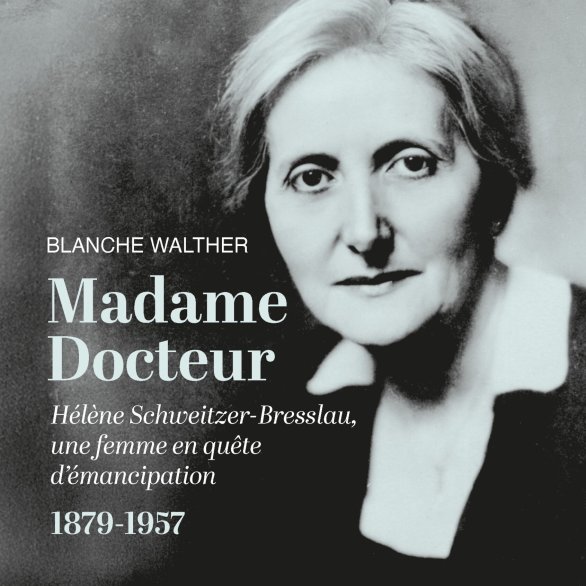
Albert Schweitzer’s former wife was a modern, free-spirited woman, one who was also plagued by doubts but proud of her convictions. A Protestant born to Jewish and German parents, Hélène Bresslau spent her youth in Strasbourg, where the constraints of a bourgeois upbringing for girls did not satisfy her. After training as a schoolteacher, she became involved in social work and then studied to become a nurse. In her adopted home of Alsace, she formed an intellectual friendship—coupled with a free-spirited romance—with the young pastor and future physician Albert Schweitzer. Although opposed to marriage—and the confinement it represented for women—she nevertheless married him in 1912 to help him found a hospital in French Gabon, where she earned the nickname “Madame Docteur.” While raising her young daughter Rhéna alone and battling a long-term bout of tuberculosis, Hélène was a woman of letters, a publisher, and a lecturer, and led an active and enterprising life in Europe, the United States, and Africa. For posterity, she remained in the shadow of her Nobel Peace Prize-winning husband… when she wasn’t simply forgotten.
A feminist and inspiring biography, Blanche Walther’s book finally shines a light on Hélène Bresslau and analyzes her life within its broader context—spanning France and Germany—in a world in the midst of upheaval.
A feminist and inspiring biography, Blanche Walther’s book finally shines a light on Hélène Bresslau and analyzes her life within its broader context—spanning France and Germany—in a world in the midst of upheaval.
This text was translated by an AI.