Sunday, March 15, 2026, is the last opportunity to view the cabinet exhibition "Bilderwelten // Weltenbilder. The Peter Jacobi photo collection. Celebrating the artist's 90th birthday" at the Transylvanian Museum.
The exhibition will close at 2 p.m. on the same day with a lecture by Dr. Ingrid Schiel, Managing Director of the Transylvanian Institute at the University of Heidelberg and Head of the Transylvanian Library and Archive, on the indexing and digitization of Peter Jacobi's photo collection.
The sculptor and photographer Peter Jacobi is one of the most important contemporary artists of Transylvanian origin. As early as 1970, Peter Jacobi represented Romania at the Venice Biennale. This was followed by numerous solo exhibitions, including at the Chicago Museum of Contemporary Art in 1981 and the Musée d'Art Moderne de Paris in 1984. After emigrating to the Federal Republic of Germany, he held a professorship at the University of Design in Pforzheim from 1971 to 1998 and designed the Holocaust Memorial in Bucharest, which was inaugurated in 2009.
For more than 50 years, artistic engagement with the culture of remembrance has been a central theme in the work of the artist, who was born in 1935. Over the decades, he has amassed a unique collection of historical photographs for his work. Peter Jacobi donated large parts of it to the Transylvanian Institute at the University of Heidelberg and the Transylvanian Museum in 2024.
Both institutions are now presenting a small selection of this extensive collection to the public for the first time in this cabinet exhibition to mark the artist's 90th birthday.
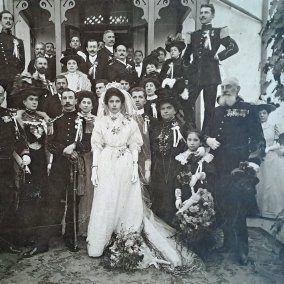
The multifaceted collection of private, documentary, art and press photographs spans a wide range from the beginnings of photography in the mid-19th century to the 1980s.
The subjects covered are just as broad, ranging from family portraits to cityscapes, ethnological photographs and documentary photographs of historically significant events. Geographically, the collection focuses on works with Romanian or Transylvanian references.
The photographs thus also bear witness to the quality of long-gone professional and amateur photo studios in Transylvania and far beyond, for example in Chișinău (today the Republic of Moldova) or Odessa (today Ukraine).
The collection is not only important for the general history of the world, but in particular for the history of migration, local history, contemporary history, economic and social history, everyday and cultural history as well as for biographical research in Transylvania and Romania.
In 2025, the Transylvanian Institute opened up and digitized the part of the collection thematically related to Transylvania and Romania for the first time. In her lecture, Dr. Ingrid Schiel will provide insights into the indexing and digitization project as well as the future possibilities of using the digitized material for research and the interested public.
The exhibition will close at 2 p.m. on the same day with a lecture by Dr. Ingrid Schiel, Managing Director of the Transylvanian Institute at the University of Heidelberg and Head of the Transylvanian Library and Archive, on the indexing and digitization of Peter Jacobi's photo collection.
The sculptor and photographer Peter Jacobi is one of the most important contemporary artists of Transylvanian origin. As early as 1970, Peter Jacobi represented Romania at the Venice Biennale. This was followed by numerous solo exhibitions, including at the Chicago Museum of Contemporary Art in 1981 and the Musée d'Art Moderne de Paris in 1984. After emigrating to the Federal Republic of Germany, he held a professorship at the University of Design in Pforzheim from 1971 to 1998 and designed the Holocaust Memorial in Bucharest, which was inaugurated in 2009.
For more than 50 years, artistic engagement with the culture of remembrance has been a central theme in the work of the artist, who was born in 1935. Over the decades, he has amassed a unique collection of historical photographs for his work. Peter Jacobi donated large parts of it to the Transylvanian Institute at the University of Heidelberg and the Transylvanian Museum in 2024.
Both institutions are now presenting a small selection of this extensive collection to the public for the first time in this cabinet exhibition to mark the artist's 90th birthday.
The multifaceted collection of private, documentary, art and press photographs spans a wide range from the beginnings of photography in the mid-19th century to the 1980s.
The subjects covered are just as broad, ranging from family portraits to cityscapes, ethnological photographs and documentary photographs of historically significant events. Geographically, the collection focuses on works with Romanian or Transylvanian references.
The photographs thus also bear witness to the quality of long-gone professional and amateur photo studios in Transylvania and far beyond, for example in Chișinău (today the Republic of Moldova) or Odessa (today Ukraine).
The collection is not only important for the general history of the world, but in particular for the history of migration, local history, contemporary history, economic and social history, everyday and cultural history as well as for biographical research in Transylvania and Romania.
In 2025, the Transylvanian Institute opened up and digitized the part of the collection thematically related to Transylvania and Romania for the first time. In her lecture, Dr. Ingrid Schiel will provide insights into the indexing and digitization project as well as the future possibilities of using the digitized material for research and the interested public.
This text was translated by an AI.