Dr. Folke Damminger, State Office for Monument Preservation Baden-Württemberg, Karlsruhe office
Location: Rastatt City Museum
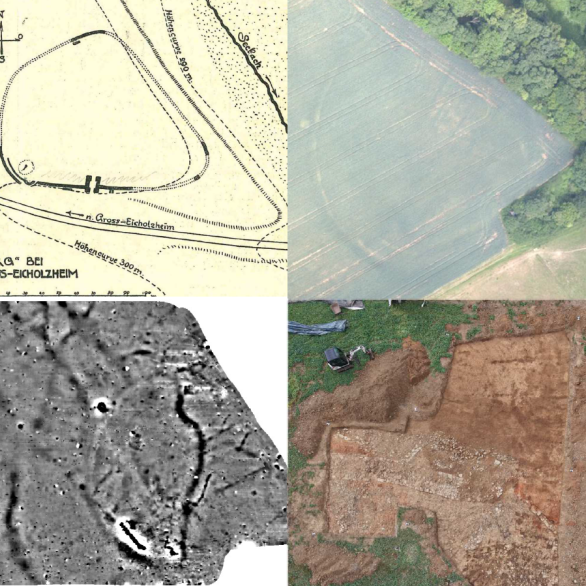
In 1897 and 1898, the well-known archaeologist Karl Schumacher carried out his first excavations at the fortifications located to the east of the Seckach district of Großeicholzheim during his work as a route commissioner on the Limes. Although he initially thought it was late Roman due to its irregular shape, it proved to be Carolingian in the course of his investigations. His discovery coincided with an increased focus on the archaeology of this period and quickly found its way into early medieval research.
Dr. Folke Damminger (Landesamt für Denkmalpflege Baden-Württemberg, Karlsruhe office) reports on how aerial archaeology brought the site back into the focus of science after more than a century of slumber. A small research excavation by the State Office for the Preservation of Monuments finally took place there in 2025, the results of which will be reported on.
Participation is free of charge, registration is not necessary.
Location: Rastatt City Museum
In 1897 and 1898, the well-known archaeologist Karl Schumacher carried out his first excavations at the fortifications located to the east of the Seckach district of Großeicholzheim during his work as a route commissioner on the Limes. Although he initially thought it was late Roman due to its irregular shape, it proved to be Carolingian in the course of his investigations. His discovery coincided with an increased focus on the archaeology of this period and quickly found its way into early medieval research.
Dr. Folke Damminger (Landesamt für Denkmalpflege Baden-Württemberg, Karlsruhe office) reports on how aerial archaeology brought the site back into the focus of science after more than a century of slumber. A small research excavation by the State Office for the Preservation of Monuments finally took place there in 2025, the results of which will be reported on.
Participation is free of charge, registration is not necessary.
This text was translated by an AI.