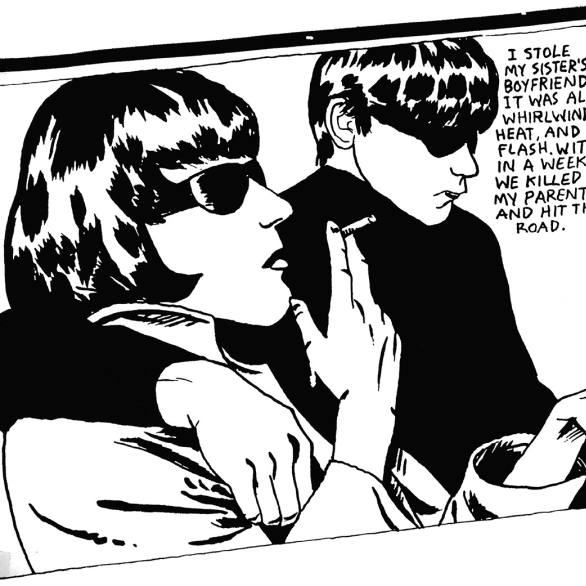
The American artist Raymond Pettibon (* 1957 Tucson, Arizona) is regarded as a revelatory chronicler of the present whose works question the defining imagery and narratives of the twentieth and twenty-first centuries. He draws upon a wide range of sources, including literature, art history, popular culture, religion, politics, and sports. Equally inspired by comics and the traditions of satire and social criticism from the eighteenth and nineteenth centuries, Pettibon combines images and text in a poetic and critical way to create an unsparing assessment of the American Dream.
Pettibon’s artistic beginnings lie in the Los Angeles punk-rock scene of the late 1970s, when he provided various bands, including Black Flag and the Minutemen, his drawings to use on their album covers and flyers, many of which are now iconic, such as Sonic Youth’s Goo (1990). His continued collaborations with musicians, alongside his own projects on vinyl, either as a musician or a producer, further testify to his connection to music.
With more than two hundred objects on loan from the collection of Stefan Thull, the exhibition at the Wilhelm-Hack-Museum is the first comprehensive presentation of this aspect of Pettibon’s oeuvre. It presents vinyl records in their various formats as well as cassettes, CDs, and DVDs from 1979 to the present day and is complemented by flyers and fanzines.
The exhibition is accompanied by a publication in a German and an English edition with essays by Max Dax, Robert Eikmeyer, Kim Gordon and Ulrich Loock, and a catalogue raisonné of Pettibon’s album artwork (Hatje Cantz Verlag/ David Zwirner Books).
Curator: Dr. Astrid Ihle
Pettibon’s artistic beginnings lie in the Los Angeles punk-rock scene of the late 1970s, when he provided various bands, including Black Flag and the Minutemen, his drawings to use on their album covers and flyers, many of which are now iconic, such as Sonic Youth’s Goo (1990). His continued collaborations with musicians, alongside his own projects on vinyl, either as a musician or a producer, further testify to his connection to music.
With more than two hundred objects on loan from the collection of Stefan Thull, the exhibition at the Wilhelm-Hack-Museum is the first comprehensive presentation of this aspect of Pettibon’s oeuvre. It presents vinyl records in their various formats as well as cassettes, CDs, and DVDs from 1979 to the present day and is complemented by flyers and fanzines.
The exhibition is accompanied by a publication in a German and an English edition with essays by Max Dax, Robert Eikmeyer, Kim Gordon and Ulrich Loock, and a catalogue raisonné of Pettibon’s album artwork (Hatje Cantz Verlag/ David Zwirner Books).
Curator: Dr. Astrid Ihle