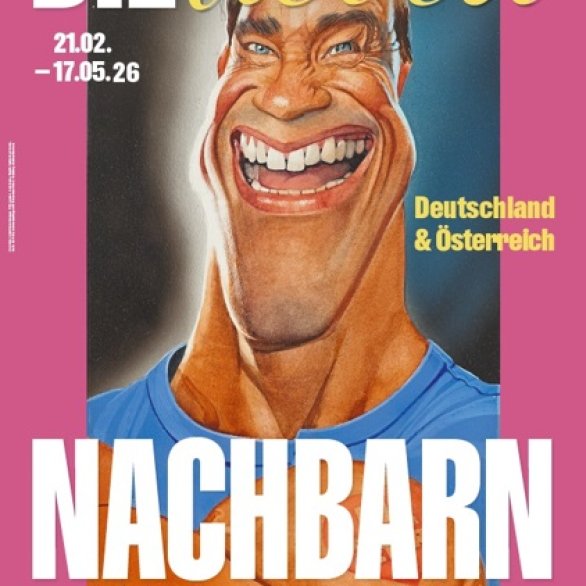
"Küss' die Hand...", "Dös geht sich aus" or "Habe die Ehre" are phrases we are familiar with, but it is not the Germans who use them, but our neighbors - the Austrians. From a German perspective, their charm is often generalized under the term "Wiener Schmäh". From an Austrian perspective, the German "Piefkes" are often seen as over-correct, sometimes even opinionated. The jibes do not detract from the mutual sympathy, as Austria is a popular cultural, sporting and culinary destination for Germans and Germany is also one of the most important neighboring countries for Austrians. Political developments are also closely followed across the borders.
In collaboration with the Museum Wilhelm Busch - Deutsches Museum für Karikatur & Zeichenkunst, Hanover, Galerie Stihl Waiblingen is showing the exhibition "Die lieben Nachbarn! Germany and Austria", which explores the fundamental questions of what distinguishes the two countries from each other, but above all what they have in common, what unites them and what values they share. No medium could be better suited for this examination than the caricature, which takes a close look at society and politics. Originally produced for local newspapers and the local readership, the caricatures by German and Austrian artists are particularly exciting to juxtapose. Among them are well-known names such as Gerhard Haderer, Manfred Deix, Erich Sokol, Petar Pismestrović, Miriam Wurster, Ruth Hebler, Detlef Beck and Peter Gaymann, who hold up a mirror to us every day and make us laugh, but also make us think.
In collaboration with the Museum Wilhelm Busch - Deutsches Museum für Karikatur & Zeichenkunst, Hanover, Galerie Stihl Waiblingen is showing the exhibition "Die lieben Nachbarn! Germany and Austria", which explores the fundamental questions of what distinguishes the two countries from each other, but above all what they have in common, what unites them and what values they share. No medium could be better suited for this examination than the caricature, which takes a close look at society and politics. Originally produced for local newspapers and the local readership, the caricatures by German and Austrian artists are particularly exciting to juxtapose. Among them are well-known names such as Gerhard Haderer, Manfred Deix, Erich Sokol, Petar Pismestrović, Miriam Wurster, Ruth Hebler, Detlef Beck and Peter Gaymann, who hold up a mirror to us every day and make us laugh, but also make us think.
This text was translated by an AI.