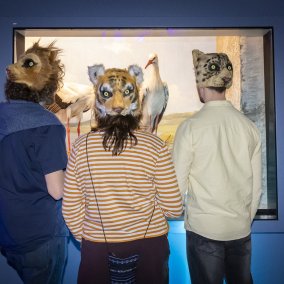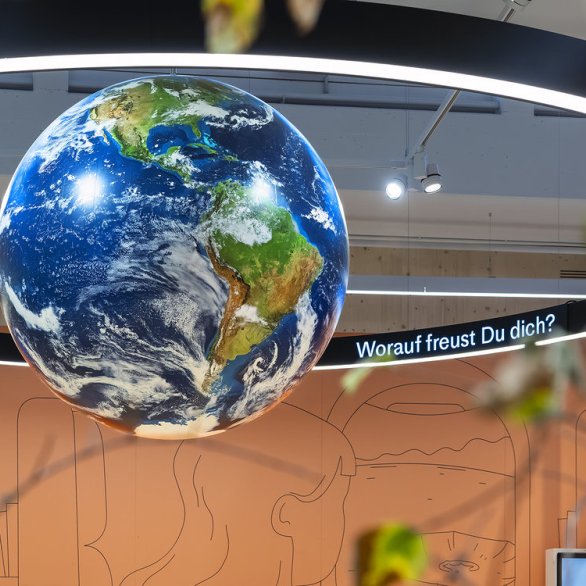
Earth's history live: A new 630 m² exhibition takes you from monster swamps and dinosaurs to future visions. It focuses on the greatest challenge of our time: the human-made climate change.
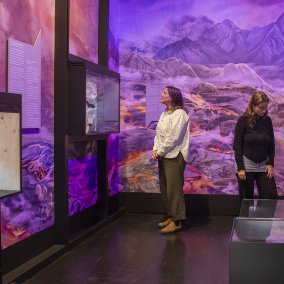
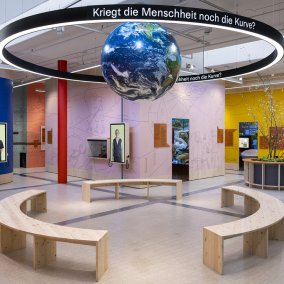
From monster swamps to fiery worlds, from the extinction of the dinosaurs to visions of the future: covering 630 square meters, the exhibition invites visitors on an exciting journey through Earth’s history with a focus on the greatest challenge of our time: anthropogenic climate change.
Brief Introduction
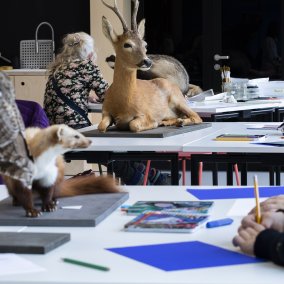
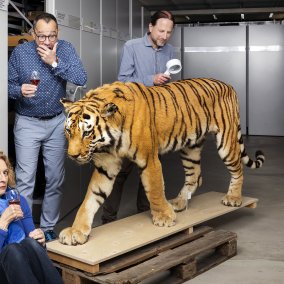
Join us on a journey through time! With visually striking displays, the exhibition reveals unusual connections and sharpens our view of the unique spaceship we call Earth, which has been carrying us for millions of years. It highlights the value of fossils as evidence and testimonies of life. After all, it is thanks to research into fossils that we know what we know today. For example, that 300 million years ago swampy forests covered the whole of Europe, providing material for vast coal deposits – the same fossil coal whose combustion now releases huge amounts of CO2 and warms the planet. Or that 250 million years ago, the Earth’s atmosphere was poisoned by gigantic volcanic eruptions. The water in the seas, lakes and rivers became a hostile soup, causing over 80 percent of all animals and plants on land and in the sea to die out. Today, the study of their remains can help teach us lessons about current climate change.
Experiencing Earth’s history
The exhibition lets visitors experience the extent to which humanity and our existence are connected with the history of our planet – from the first traces of life to the distant future. A bleak outlook? Not at all! The exhibition does not gloss over anything, but it does not pay homage to dystopias or threatening scenarios either. It stands for hope rather than powerlessness, and for celebrating the flourishing life on planet Earth rather than lamenting its loss. It aims to encourage reflection and research. Unlike with the natural disasters that have always plagued our planet, we can act to combat anthropogenic global warming. There are numerous measures, innovations and visions with which we can counteract the climate crisis.
Participation project: “Ways out of the climate crisis”
How do we bring about changes that benefit everyone? We want to discuss promising ways out of the climate crisis with visitors. Which topic should receive particular attention in the exhibition over the next six months? Which climate and transformation projects are the most promising? At the interactive voting station, visitors can help determine which priorities to set and which ideas to support.
Echo group: “How does the climate affect me?”
Around a dozen people will accompany the exhibition with their presence over many years. They include an IT apprentice, an urban planner and a mountaineer. They report on how they experience the consequences of global warming. How do they feel about it and how have their attitudes, hopes and fears changed over the years? Visitors can listen for themselves on video panels in the exhibition entrance area. A new episode will be added every year.
Brief Introduction
Join us on a journey through time! With visually striking displays, the exhibition reveals unusual connections and sharpens our view of the unique spaceship we call Earth, which has been carrying us for millions of years. It highlights the value of fossils as evidence and testimonies of life. After all, it is thanks to research into fossils that we know what we know today. For example, that 300 million years ago swampy forests covered the whole of Europe, providing material for vast coal deposits – the same fossil coal whose combustion now releases huge amounts of CO2 and warms the planet. Or that 250 million years ago, the Earth’s atmosphere was poisoned by gigantic volcanic eruptions. The water in the seas, lakes and rivers became a hostile soup, causing over 80 percent of all animals and plants on land and in the sea to die out. Today, the study of their remains can help teach us lessons about current climate change.
Experiencing Earth’s history
The exhibition lets visitors experience the extent to which humanity and our existence are connected with the history of our planet – from the first traces of life to the distant future. A bleak outlook? Not at all! The exhibition does not gloss over anything, but it does not pay homage to dystopias or threatening scenarios either. It stands for hope rather than powerlessness, and for celebrating the flourishing life on planet Earth rather than lamenting its loss. It aims to encourage reflection and research. Unlike with the natural disasters that have always plagued our planet, we can act to combat anthropogenic global warming. There are numerous measures, innovations and visions with which we can counteract the climate crisis.
Participation project: “Ways out of the climate crisis”
How do we bring about changes that benefit everyone? We want to discuss promising ways out of the climate crisis with visitors. Which topic should receive particular attention in the exhibition over the next six months? Which climate and transformation projects are the most promising? At the interactive voting station, visitors can help determine which priorities to set and which ideas to support.
Echo group: “How does the climate affect me?”
Around a dozen people will accompany the exhibition with their presence over many years. They include an IT apprentice, an urban planner and a mountaineer. They report on how they experience the consequences of global warming. How do they feel about it and how have their attitudes, hopes and fears changed over the years? Visitors can listen for themselves on video panels in the exhibition entrance area. A new episode will be added every year.