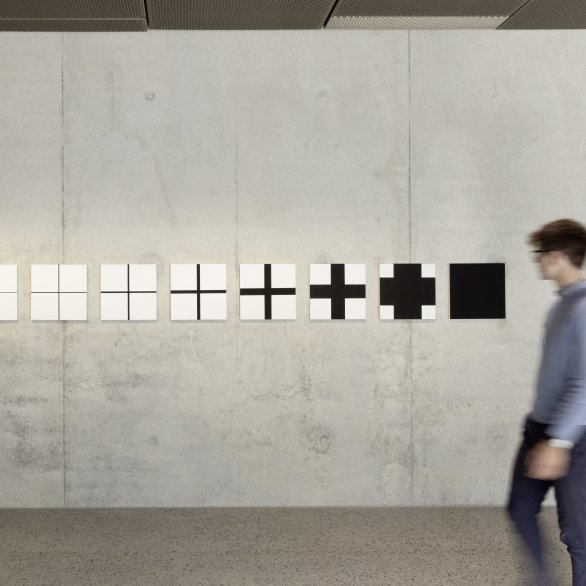
François Morellet (1926–2016) is considered one of the most important figures in Geometric Abstraction. His works follow a systematic and logical approach, yet remain playful and full of wit. To mark the 100th anniversary of his birth, the Würth Collection is dedicating a retrospective to this versatile pioneer of a new Concrete Art movement, while also highlighting his fellow artists and kindred spirits, such as Max Bill, Almir Mavignier, and Anni Albers.
As of the 1950s, Morellet’s works were strikingly consistent. He developed a distinctive visual language based on his formal geometrical inventiveness and systematic concepts. Each work complies with ordering principles which he himself defined as juxtaposition, superimposition, chance, interference or fragmentation. Having started with painting, he was one of the first artists to work with artificial light in the 1960s. Of the artist’s numerous projects in the public domain, the works that stand out particularly are those he realised for the Louvre in Paris and the Paul Löbe Haus, parliamentary building of the German Bundestag in Berlin.
There is of course much more to Morellet’s oeuvre than his clear stylistic idiom. Through the use of titles, which are full of allusions and wordplay, the “non-linguistic” aspect of abstract art is often extended and is especially apt in French. These open up interpretational possibilities for viewers that are both intellectual and entertaining. The artist speaks of "collisions" and describes his work as being “almost nothing” (“Presque rien”), although not without challenging us to read whatever we want into that “nothing”. The exhibition may be understood, therefore, as an invitation to enter into a cheerful and serious dialogue with works of art that ascribe an active role to us as viewers.
At an interactive station in the exhibition, you can create your own “artwork” titled Pi piquant according to a system by François Morellet.