Among other things, the London-based media artist deals with automatic speech recognition and its susceptibility to errors. She opposes the smoothing of language in digital contexts and instead focuses our attention on the untranslatable. The guided tour provides an insight into the background to the exhibition.
About the exhibition:
In a digital context that leads us to believe in seamless and immediate communication, the physical friction in language becomes something that needs to be smoothed out. Systems such as automatic speech recognition are shaped by hegemonic notions of which voices count and which linguistic forms are worthy of recognition.
Anna Barham (*1974, Sutton Coldfield), who is presenting her first comprehensive solo exhibition in Germany, eludes this smoothing of language and instead places the untranslatable and irreducible at the center of our attention. Her artistic practice combines language with the pictorial and performative in order to crystallize the associative meanings that can be inherent in a word, but only come to light through a new shift in its individual parts.
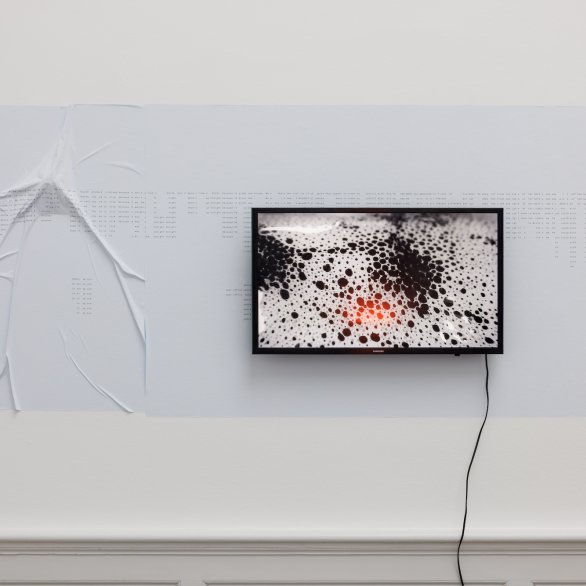
Barham treats language as both sculptural and acoustic material and fills the exhibition with sounds and voices. Hands form and deform letters from geometric surfaces; text snakes through the exhibition spaces, around and over the institutional architecture and its furnishings; a large-format UV printer produces words and images; and the incessant call of a cicada can be heard from the furthest room.
Since 2013, Anna Barham has been working with the error-prone nature of speech recognition to open up new meanings and foreground the materiality of the voice and its interruptions. For the artist, it is precisely these textures and processes of interrogation that constitute the potential of the voice. In her new sound work ZYX (2026), she views the errors caused by automatic speech recognition as hallucinations. What initially appears to be a misperceived text is instead a new way of thinking and writing in radical opposition to automation, standardization and authority.
Curated by Anja Casser
The exhibition is funded by the Art Innovation Fund of the Baden-Württemberg Ministry of Science, Research and the Arts and can be seen until June 14, 2026.
About the exhibition:
In a digital context that leads us to believe in seamless and immediate communication, the physical friction in language becomes something that needs to be smoothed out. Systems such as automatic speech recognition are shaped by hegemonic notions of which voices count and which linguistic forms are worthy of recognition.
Anna Barham (*1974, Sutton Coldfield), who is presenting her first comprehensive solo exhibition in Germany, eludes this smoothing of language and instead places the untranslatable and irreducible at the center of our attention. Her artistic practice combines language with the pictorial and performative in order to crystallize the associative meanings that can be inherent in a word, but only come to light through a new shift in its individual parts.
Barham treats language as both sculptural and acoustic material and fills the exhibition with sounds and voices. Hands form and deform letters from geometric surfaces; text snakes through the exhibition spaces, around and over the institutional architecture and its furnishings; a large-format UV printer produces words and images; and the incessant call of a cicada can be heard from the furthest room.
Since 2013, Anna Barham has been working with the error-prone nature of speech recognition to open up new meanings and foreground the materiality of the voice and its interruptions. For the artist, it is precisely these textures and processes of interrogation that constitute the potential of the voice. In her new sound work ZYX (2026), she views the errors caused by automatic speech recognition as hallucinations. What initially appears to be a misperceived text is instead a new way of thinking and writing in radical opposition to automation, standardization and authority.
Curated by Anja Casser
The exhibition is funded by the Art Innovation Fund of the Baden-Württemberg Ministry of Science, Research and the Arts and can be seen until June 14, 2026.
This text was translated by an AI.