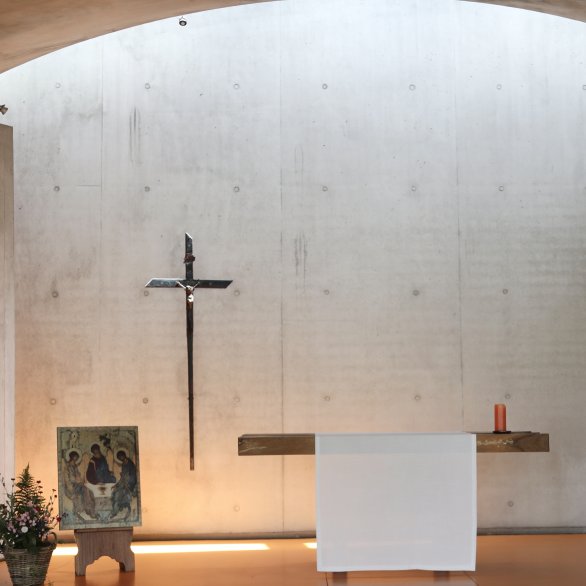
This guided tour offers an insight into the Sainte-Claire monastery, located on the Colline de Bourlémont in Ronchamp. Led by one of the Poor Clare sisters, it offers privileged access to areas usually closed to the public, and provides a simple, straightforward insight into the daily life of a contemporary monastic community.
From the very first steps, the visit is distinguished by its intimate character. Guided by a sister from the monastery, visitors are invited to enter a place designed for silence, work and prayer. This presence gives the visit a particular human dimension, far removed from any theoretical or institutional discourse. The visit is rooted in the day-to-day experience of the people who live here.
The tour takes in several areas of the monastery that are usually inaccessible: the work rooms, where the sisters devote a large part of their day to manual activities, and the cells, the sober, functional rooms that reflect the simplicity of monastic life.
The visit is also an opportunity to learn more about the monastery's architectural project, designed by Renzo Piano and his RPBW agency.
Far from a purely architectural visit, the tour highlights the close link between the building and the life it shelters. The monastery is presented not as a fixed work of art, but as a living space, shaped by the community's gestures, movements and times of silence.
This guided tour is aimed at all audiences, whether interested in contemporary architecture, monastic life or simply curious to discover a rare place. It offers a pause for listening and observation, in a setting marked by calm and sobriety.
From the very first steps, the visit is distinguished by its intimate character. Guided by a sister from the monastery, visitors are invited to enter a place designed for silence, work and prayer. This presence gives the visit a particular human dimension, far removed from any theoretical or institutional discourse. The visit is rooted in the day-to-day experience of the people who live here.
The tour takes in several areas of the monastery that are usually inaccessible: the work rooms, where the sisters devote a large part of their day to manual activities, and the cells, the sober, functional rooms that reflect the simplicity of monastic life.
The visit is also an opportunity to learn more about the monastery's architectural project, designed by Renzo Piano and his RPBW agency.
Far from a purely architectural visit, the tour highlights the close link between the building and the life it shelters. The monastery is presented not as a fixed work of art, but as a living space, shaped by the community's gestures, movements and times of silence.
This guided tour is aimed at all audiences, whether interested in contemporary architecture, monastic life or simply curious to discover a rare place. It offers a pause for listening and observation, in a setting marked by calm and sobriety.
This text was translated by an AI.